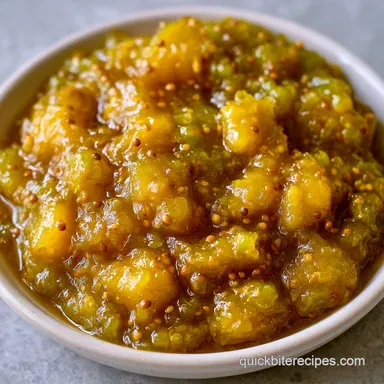
Mango Chutney: Simple and Tangy

- Time: 15 min active + 60 min simmering = Total 75 mins
- Flavor/Texture Hook: Tangy, syrupy glaze with tender fruit chunks
- Perfect for: Easy meal prep, gifting, or a bold condiment for proteins
- Simple and Tangy Mango Chutney
- The Texture Secret
- Component Analysis
- What You'll Need
- Necessary Kitchen Gear
- Cooking Steps Explained
- Fixing Common Glitches
- Troubleshooting Common Issues
- Swaps and Tweaks
- Adjusting Batch Size
- Fact Checking the Folklore
- Storage and Waste
- Serving and Plating
- Recipe FAQs
- 📝 Recipe Card
That first pop pop pop of mustard seeds hitting hot oil is the signal that everything is about to get interesting. I remember the first time I tried this, I used mangoes that were way too ripe, and the whole thing turned into a sweet, mushy jam.
It wasn't wrong, but it lacked that signature "zing" that makes this dish a condiment rather than a dessert.
Once I switched to green mangoes, everything clicked. The tartness of the fruit fights back against the coconut sugar, creating a velvety glaze that clings to every piece of fruit. It's the kind of thing you make once and then realize you want it on everything from grilled cheese to roast chicken.
This Mango Chutney is all about the contrast. We're layering heat from the chili flakes, warmth from the cinnamon, and a sharp edge from the apple cider vinegar. It's a quick win because you don't need fancy equipment, just one heavy pot and a little bit of patience while it simmers down.
Simple and Tangy Mango Chutney
The real magic here is how a few basic pantry staples transform a hard, sour fruit into something complex. You don't need a professional kitchen to get that deep, concentrated flavor. Trust me on this, the secret is just letting the liquid reduce until it looks like liquid gold.
If you've ever bought the store-bought stuff, you know it can be cloyingly sweet. Making your own Mango Chutney allows you to control the balance. I prefer mine with a bit more of a kick, so I often lean heavier on the ginger and chili.
It's a versatile addition to any meal, providing a bright contrast to rich, fatty foods.
Right then, let's get into how this actually works before we start chopping. This isn't just about boiling fruit, it's about creating a stable preserve that tastes better every day it sits in the jar.
The Texture Secret
Sugar Bind: Coconut sugar doesn't just add sweetness, it thickens the vinegar into a syrupy coat. This prevents the fruit from feeling "wet" and instead gives it a glossy, sticky finish.
Pectin Release: Green mangoes are naturally high in pectin. According to Serious Eats, pectin is what allows jams and chutneys to set, so as the fruit simmers, it naturally thickens the sauce without needing cornstarch.
Acid Balance: The apple cider vinegar breaks down the tough fibers of the green mango. This ensures the chunks are tender enough to eat but don't completely dissolve into a puree.
Aromatic Infusion: Sautéing the mustard seeds and ginger first allows the fat soluble flavors to bloom. This means the warmth is distributed through the entire batch of Mango Chutney rather than just tasting like raw ginger.
| Approach | Prep Time | Texture | Best For |
|---|---|---|---|
| Fresh Green Mango | 15 mins | Chunky & Firm | Traditional serving, gifting |
| Jam Shortcut | 5 mins | Smooth & Syrupy | Quick glaze, dipping sauce |
| Ripe Mango | 10 mins | Soft & Jammy | Sweet toast, dessert topping |
The choice between fresh and shortcut really comes down to how much "bite" you want. I always go for the fresh route because that firm texture is what makes it feel like a real condiment.
Component Analysis
| Ingredient | Science Role | Pro Secret |
|---|---|---|
| Green Mango | Pectin Source | Dice them into exact 1/4 inch cubes for even cooking |
| Coconut Sugar | Caramelizer | Use for a deeper, toasted flavor compared to white sugar |
| Apple Cider Vinegar | Preservative | Adds a fruity acidity that complements the mango |
| Mustard Seeds | Flavor Pop | Wait for the "pop" to ensure they aren't bitter |
What You'll Need
For this Mango Chutney, we're keeping things budget-friendly. You can find green mangoes at most Asian grocery stores for a fraction of the price of ripe ones.
- 2 tbsp neutral oil Why this? High smoke point, doesn't mask the spices
- 1 tsp yellow mustard seeds Why this? Adds a nutty, pungent base
- 1 medium yellow onion, finely diced Why this? Provides savory depth
- 3 cloves garlic, minced Why this? Sharp aromatic punch
- 1 tbsp fresh ginger, grated Why this? Zesty warmth
- 2 lbs green mangoes, peeled and diced into 1/4 inch cubes Why this? Necessary for the tart flavor and set
- 1/2 cup apple cider vinegar Why this? Balanced acidity
- 1/2 cup coconut sugar Why this? Earthy sweetness
- 1/4 cup golden raisins Why this? Small bursts of sweetness
- 1/2 tsp red chili flakes Why this? Subtle back end heat
- 1 tsp sea salt Why this? Enhances all other flavors
- 1/4 tsp ground cinnamon Why this? Adds a hidden layer of warmth
| Original Ingredient | Substitute | Why It Works |
|---|---|---|
| Coconut Sugar | Brown Sugar | Similar molasses notes. Note: Slightly less caramel depth |
| Apple Cider Vinegar | White Vinegar | Sharp acidity. Note: Lacks the fruity undertone |
| Golden Raisins | Dried Cranberries | Tart sweetness. Note: Adds a red tint to the chutney |
| Neutral Oil | Ghee | Richer flavor. Note: More authentic Indian profile |
I've found that using a bit of ghee instead of oil really makes this Mango Chutney feel more traditional, but neutral oil is the best budget option.
Necessary Kitchen Gear
You don't need a mountain of gadgets for this. A heavy bottomed stainless steel pot or a Dutch oven is the way to go. Because we're simmering for an hour, you want something that distributes heat evenly so the sugar doesn't burn at the bottom.
A sharp chef's knife is essential for getting those mangoes into consistent 1/4 inch cubes. If the pieces are different sizes, some will turn to mush while others stay hard. I also suggest a potato masher for the final touch.
Finally,, have some sterilized glass jars ready. Since this Mango Chutney has a high acid and sugar content, it keeps well, but clean jars are a must to prevent any spoilage.
Cooking Steps Explained
- Heat the neutral oil over medium heat in your heavy pot. Add the mustard seeds and wait until they begin to pop and sizzle, which usually takes about 2 minutes.
- Stir in the diced onion and sauté until translucent and soft. Add the minced garlic and grated ginger, stirring for 60 seconds until the aroma becomes pungent and nutty.
- Toss in the diced green mangoes, golden raisins, and red chili flakes. Stir well to coat the fruit in the aromatic oil.
- Pour in the apple cider vinegar and sprinkle the coconut sugar, sea salt, and ground cinnamon over the top.
- Bring the mixture to a gentle boil, then immediately reduce the heat to low.
- Simmer uncovered for 45-60 minutes, stirring occasionally, until the liquid has reduced to a thick, syrupy glaze and the mangoes are tender but still hold their shape.
- Remove the pot from the heat. Use a potato masher to lightly crush about 20% of the mango chunks. Note: This creates a velvety base for the remaining whole chunks.
- Let the chutney cool completely in the pot before transferring to sterilized glass canning jars.
This cooling period is where the flavors fuse. If you jar it while it's boiling, you risk creating too much condensation, which can shorten the shelf life of your Mango Chutney.
Fixing Common Glitches

When I first started making this, I always struggled with the consistency. Sometimes it was a soup, sometimes it was a brick. The trick is watching the bubbles. As the sauce thickens, the bubbles get larger and slower.
Troubleshooting Common Issues
| Issue | Solution |
|---|---|
| Why Your Chutney Is Too Runny | This usually happens if the heat was too low or you didn't simmer it long enough. The sugar hasn't fully bonded with the pectin yet. |
| Why Your Chutney Is Too Tart | If the mangoes were exceptionally sour, the coconut sugar might be overwhelmed. You can fix this by adding a tablespoon of honey or maple syrup at the very end. |
| Why Your Mangoes Disintegrated | This is a result of over stirring or using mangoes that were too ripe. Be gentle with the spoon during the simmer. |
Consistency Checklist:
- ✓ Mustard seeds popped before adding onions
- ✓ Mangoes cut to uniform 1/4 inch size
- ✓ Liquid reduced to a syrupy glaze
- ✓ 20% of fruit mashed for texture
- ✓ Fully cooled before jarring
Swaps and Tweaks
If you're looking to change the vibe of your Mango Chutney, there are a few ways to do it without ruining the batch. For those who want more heat, I recommend adding a finely chopped bird's eye chili along with the ginger.
Adding Tropical Flair
Try swapping the raisins for dried pineapple bits. This boosts the tropical profile and adds a different kind of chewiness to the finish. It makes the Mango Chutney feel a bit more modern.
Using Ripe Mangoes
If you can't find green mangoes, you can use ripe ones, but you must increase the vinegar by 1/4 cup and reduce the sugar by half. The result will be more like a jam than a traditional chutney.
Glazing Proteins
This isn't just a condiment. I love using this Mango Chutney as a glaze for salmon or chicken. Just brush it on during the last 5 minutes of grilling to get a caramelized, sticky crust. If you're craving something sweet after a spicy meal, my Mango Sago dessert is a total dream and uses similar flavor profiles.
Adjusting Batch Size
When you're making this for a crowd, don't just multiply everything linearly. Spices can become overwhelming if you simply double them.
Scaling Down (Half Batch): Use a smaller saucepan to prevent the liquid from evaporating too quickly. Reduce the simmering time by about 20% since there's less mass to heat up. For the onion, just use a small one.
Scaling Up (Double or Triple): Increase the oil and vinegar as normal, but only increase the cinnamon and chili flakes by 1.5x. The intensity of these spices builds up. Work in a very large Dutch oven to ensure there's enough room for the fruit to move without mashing.
If you're making a massive batch, be prepared for a longer cooling time. A giant pot of Mango Chutney holds heat for a long time, and putting a hot jar in the fridge can raise the internal temperature of your refrigerator.
Fact Checking the Folklore
There is a common belief that you have to ferment chutney for weeks to get the "real" flavor. That's just not true for this style. The combination of vinegar and slow simmering mimics that aged tang in about an hour.
Some people also claim that you must use a pressure cooker to soften green mangoes. While it's faster, it often obliterates the texture of the fruit. A slow simmer on the stove is the only way to ensure the chunks stay intact.
Finally,, don't believe the myth that you can't use coconut sugar. Some traditionalists insist on cane sugar, but coconut sugar actually provides a deeper, more complex caramel note that pairs better with the ginger.
Storage and Waste
Store your Mango Chutney in the fridge for up to 3 months. Because of the high sugar and acid content, it's naturally preserved. If you've sterilized your jars and used a proper seal, it can last even longer in a cool, dark pantry.
Freezing Guidelines: You can freeze this for up to 6 months. I recommend using plastic containers rather than glass to avoid cracking. When you thaw it, the texture might be slightly softer, but the flavor remains identical.
Zero Waste Tips: Don't throw away the mango peels! You can simmer the peels in a small amount of water and sugar to make a simple mango syrup. Also, if you have leftover onion scraps from the dicing process, throw them into a freezer bag for your next homemade vegetable stock.
Serving and Plating
To make this look like it came from a high end bistro, serve it in a small ceramic ramekin with a sprig of fresh cilantro on top. The green of the herb pops beautifully against the deep amber of the Mango Chutney.
This tastes incredible on Chicken Tostadas for a fusion twist, where the acidity cuts through the fried tortilla and savory chicken. You can also dollop it onto a plate of basmati rice and grilled halloumi for a vegetarian feast.
For a party platter, place a bowl of chutney in the center, surrounded by warm naan bread, sliced cucumbers, and grilled skewers. The sticky, velvety nature of the sauce makes it the perfect dip for everything on the board.
Recipe FAQs
What is mango chutney made of?
It is a sweet and savory preserve made from green mangoes, coconut sugar, and apple cider vinegar. It is flavored with yellow mustard seeds, onion, garlic, ginger, golden raisins, red chili flakes, sea salt, and cinnamon.
What do you use mango chutney for?
Use it as a versatile condiment for savory foods. It pairs exceptionally well with grilled meats, cheese platters, and warm naan.
How to make a quick mango chutney?
Simmer the mixture uncovered for 45–60 minutes over low heat. Stir occasionally until the liquid reduces into a thick, syrupy glaze.
How are you supposed to eat mango chutney?
Serve it chilled or at room temperature as a side sauce. Its balance of sweet and tart flavors helps cut through rich, fatty proteins.
Why is my chutney too runny?
You likely didn't simmer the mixture long enough. The sugar needs sufficient time to bond with the pectin to achieve the correct thickness.
Can I freeze mango chutney?
Yes, you can freeze it for up to 6 months. Use plastic containers instead of glass to prevent the containers from cracking.
Is it true that mangoes always disintegrate during simmering?
No, this is a common misconception. Mangoes only break down if they are over-stirred or if you use fruit that is too ripe.
Mango Chutney in 75 Minutes